Tiger Tanaka
You Only Live TwiceTiger Tanaka is the head of the Japanese Secret Service, an intelligence chief whose genial manner conceals formidable authority and a keen sense of institutional honor. He becomes James Bond’s host, source, evaluator, and mission partner: first arranging access to classified material, then entrusting James Bond with the dangerous task of entering Death Castle. His loyalty is practical rather than sentimental, expressed through tests, intelligence work, and a final gesture of personal regard.
Identity and Presence
Tiger is introduced as a powerful, chunky man in a black robe, with golden teeth and a broad, creased face. His expansive smile closes his eyes to glittering slits. James Bond recognizes the expression as a mask rather than simple friendliness, an early sign that Tiger’s warmth does not make him easy to read. He can joke about James Bond’s manners and appetites while remaining alert to the balance of power between them.
His authority is not merely ceremonial. He is the senior figure within the Japanese Secret Service, and officials in Fukuoka receive him with pomp. Superintendent Ando, despite being a local police chief, treats him with marked respect. Tiger is also attentive to the social meaning of encounters: James Bond’s standing, the Superintendent’s authority, and his own standing with James Bond all matter within a world where respect can be gained or lost.
Intelligence Work and James Bond
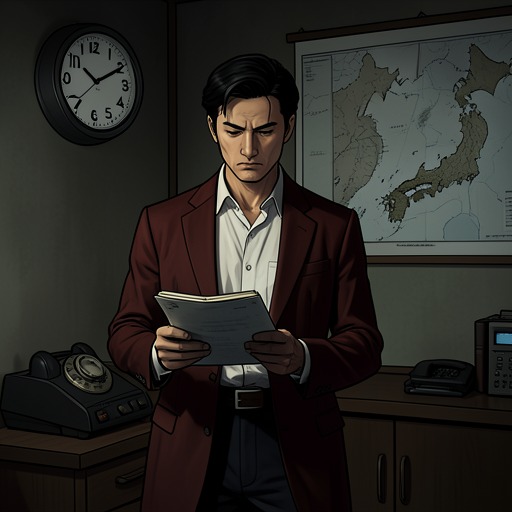
Tiger first receives James Bond in an improvised office beneath Tokyo: a disused underground station whose platform, signals, tiled walls, tunnels, and empty kiosk remain intact. Prefabricated offices fill the space above the platform, and Tiger explains that he chose it because it is quiet, private, and cool while Tokyo’s new underground remains unfinished. The unusual setting reflects his resourcefulness, as well as the limits within which his department operates. He notes that the Ministry of Internal Affairs must count its pennies, even as other offices support expensive projects of their own.
At their meeting, Tiger acknowledges that James Bond has come about MAGIC 44. He produces a pale green file marked GOKUHI, confirms that the marking means the material is top secret, and asks James Bond to swear not to disclose what he is about to read. The file contains two sheets: one covered in Japanese characters and another with about fifty typed lines. Tiger thus makes access to intelligence conditional on discretion, treating the request as a matter of trust as well as administration.
Their familiarity has a more playful side. At a gathering where James Bond is teased for his drinking, Tiger challenges him to a ridiculous game and predicts that he will not win. When James Bond boasts about Western instinct and dismisses the small sake cups, Tiger answers with a saying about how drinking gradually reverses its hold on the drinker. He can needle his friend without losing control of the encounter; humor is part of their rapport, but it also lets Tiger remind James Bond not to underestimate him or his customs.
Failure, Responsibility, and the Test
Tiger’s account of a recent failure reveals the burden beneath his composure. He describes a man whose body was terribly burned and who, in his final days, babbled a verse about dragonflies. Tiger recounts how, as a boy, the man had tied a female dragonfly to a thread to lure male dragonflies, and how the man continued repeating a poem about pink dragonflies over graves until his death. The story reaches James Bond not as detached intelligence but as a personal recollection, set amid a quiet room, sake, cigarettes, and the approach of dawn.
When James Bond asks what he did next, Tiger says he did nothing beyond apologizing to his superiors. He waited for an honorable solution and waited for James Bond to arrive. The admission connects the failure to the mission now being offered: Tiger has not simply found a useful foreign operative but has placed his hope in the one who was sent. He tests James Bond’s resolve under pressure, then explains that he had made a similar case to his Prime Minister. The Prime Minister agreed that success would demonstrate that Britain still possessed an elite capable of handling the material; failure would mean that Tiger must politely refuse the request.
The test is starkly phrased: James Bond must enter Death Castle and slay the dragon within. Tiger turns an intelligence negotiation into a personal ordeal, making the danger the proof required before classified cooperation can proceed. His challenge is neither an abstract legend nor a casual joke; it is the condition on which he has staked his judgment and his standing.
Field Partnership in Fukuoka
Tiger accompanies James Bond into the operation’s local stages. At six in the morning, a car supplied by the Prefect of Police in Fukuoka carries them north along the coast road. When James Bond spots a suspected motorcycle pursuer, Tiger looks back and immediately gives instructions to the driver. The car pulls off onto a track and waits out of sight; when the motorcycle passes, the driver turns back onto the road and pursues it. Tiger directs the response, including an attempt to stop the rider with a siren and, if that fails, to force him into a ditch. His quick cooperation shows that he takes James Bond’s suspicions seriously and can turn them into action without delay.
In Fukuoka, Tiger works with Superintendent Ando over an aerial mosaic of Death Castle and its surroundings. He relays the Superintendent’s assessment that a covert landward approach has become difficult: people intent on suicide pay local peasants to guide them through the marshes, while routes through the castle walls are continually changed and kept open for them. Twenty bodies have reached the mortuary in a week, and the Superintendent is close to resigning. Tiger’s role is both diplomatic and operational: he conveys local knowledge, observes the respect between officials, and helps James Bond assess the problem.
He then identifies a possible base on Kuro Island through the Superintendent’s family connection. Tiger explains that the Superintendent is distantly related to a family there and introduces its daughter, Kissy Suzuki. At seventeen, she had gone to Hollywood to make a film as a beautiful Japanese diving girl, but disliked Hollywood and returned to her island life despite the fortune she might have made. The press once called her the Japanese Garbo; at twenty-three, she has largely been forgotten outside the island. The family’s comfortable house, built with money she earned, offers James Bond a place to stay while the other homes are fishermen’s shacks. Tiger turns an intelligence contact into a route toward a workable cover and base.
Farewell and Narrative Role
As dusk falls, Tiger’s farewell is brief but unusually intimate. He takes James Bond’s hand in both of his, tells him he is certain he will succeed, and refrains from wishing him luck. He gives him a small box in case the venture goes very wrong; inside is a single long, brownish pill. James Bond returns it, saying that he would rather face a second life directly than turn his back on it. Tiger accepts the refusal, boards the police boat, and gives a swift downward motion with his hand as it disappears beyond the seawall.
Tiger’s combination of ceremony and practical concern defines his role in the story. He can arrange documents and transport, judge whether an ally can be trusted, coordinate with local authorities, and offer a contingency for failure without disguising the danger. Later, an agent reports that the head of the Japanese Secret Service, identified as Tanaka, had traveled south with a foreigner disguised as a Japanese person. The report confirms that Tiger’s movements have been observed by the force surrounding Death Castle, even though Tiger himself is unavailable when James Bond asks to question him. His work therefore helps make the mission possible while also placing him within the reach of the enemy’s surveillance.